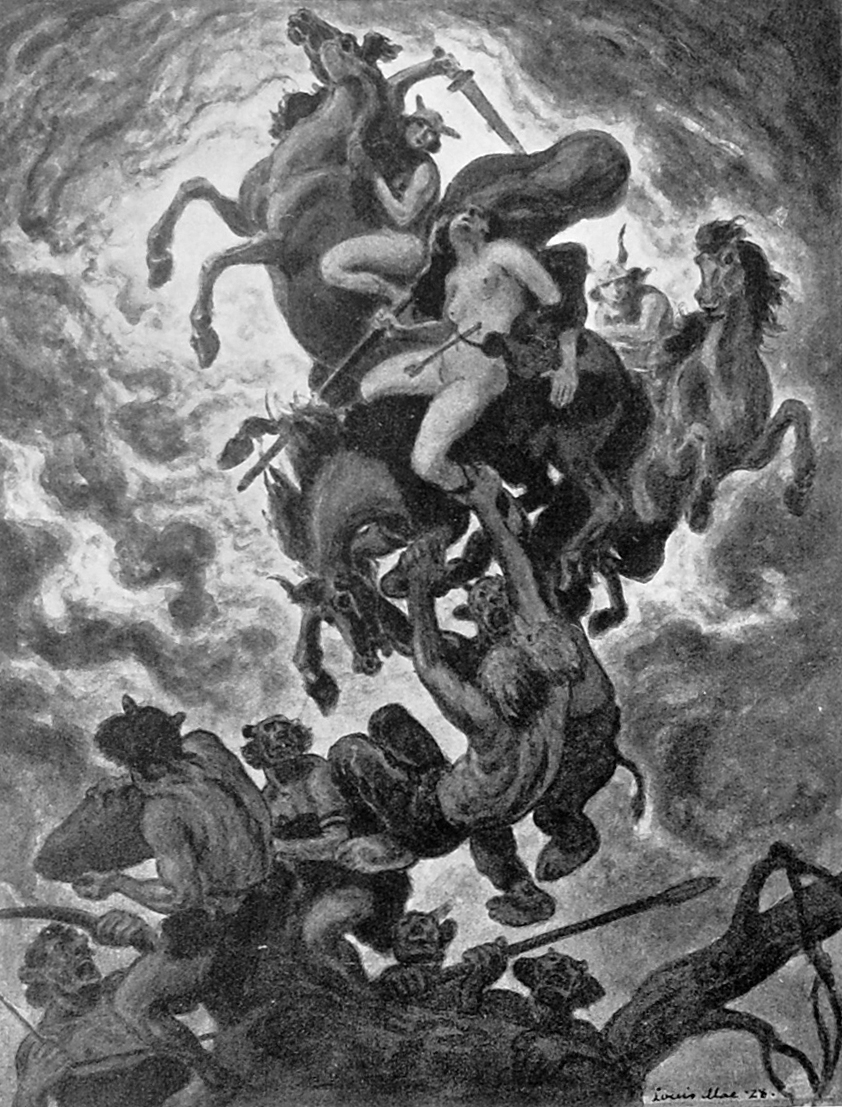
Description: Valkyries
fighting in the Battle of Ragnarok.
This scene is from Louis Moe's Ragnarok: En Billeddigtning.
Source: Ragnarok: En Billeddigtning
Folio or Page: [73]
Medium: Not known
Date: 1929
Dimensions (mm): 150 x 195
Provenance:
Gift of Estate of Richard Beck to Special Collections at the
University of Victoria. This illustration from Den Ældre Eddas Gudesange was photographed by
P. A. Baer in August 2011.
Call number: NE962 N67M64
Rights:
This illustration from Ragnarok: En
Billeddigtning is in the public domain.
Research notes, early print reviews, etc.:
Some of the illustrations in Ragnarok: En
Billeddigtning have two digit numbers, along with Louis Moe's name,
within the illustration. This one has the number 28, possibly indicating the
year 1928.
Bibliography:
Primary Sources
Moe,
Louis Maria Niels Peder
Halling. Ragnarok: En
Billeddigtning. København, A.F.
Høst, 1929.
Secondary Sources
Cleasby, Richard
and
Vigfússon
Guðbrandur
. An Icelandic-English Dictionary.
Oxford: Clarendon Press,
1957.
Simek,
Rudolf.
Angela
Hall
. Dictionary of Northern Mythology. W
Woodbridge: D. S. Brewer,
2007.
Supernatural female warriors who are closely associated with Óðinn
and decide the fate of warriors. They convey those who die in battle
to Valhöll to join the group known as einherjar who will fight on
the side of the Gods in the Battle of Ragnarök.
Árni Björnsson
notes in Wagner and the Volsungs: Icelandic Sources
of Der Ring des Nibelungen that
"the idea of the valkyries derives from the Eddas and other early
poetry. The German word Walküre is a nineteenth-century Germanistion
of the Icelandic valkyrja ('chooser of the slain') (155).
Source Materials:
Ragnarok: En Billeddigtning (da.)
Louis Moe's illustrated retelling of the Battle of Ragnarok and the
events that preceded it.
Source Persons
Moe,
Louis (no.)
b. 1857
d. 1945
Nationality: Norwegian/Danish.
Occupation: illustrator
Residence: Copenhagen
Moe was an illustrator who was born in Norway but became a Danish
citizen in 1919.