


Siegfried Tastes Fafner's Blood
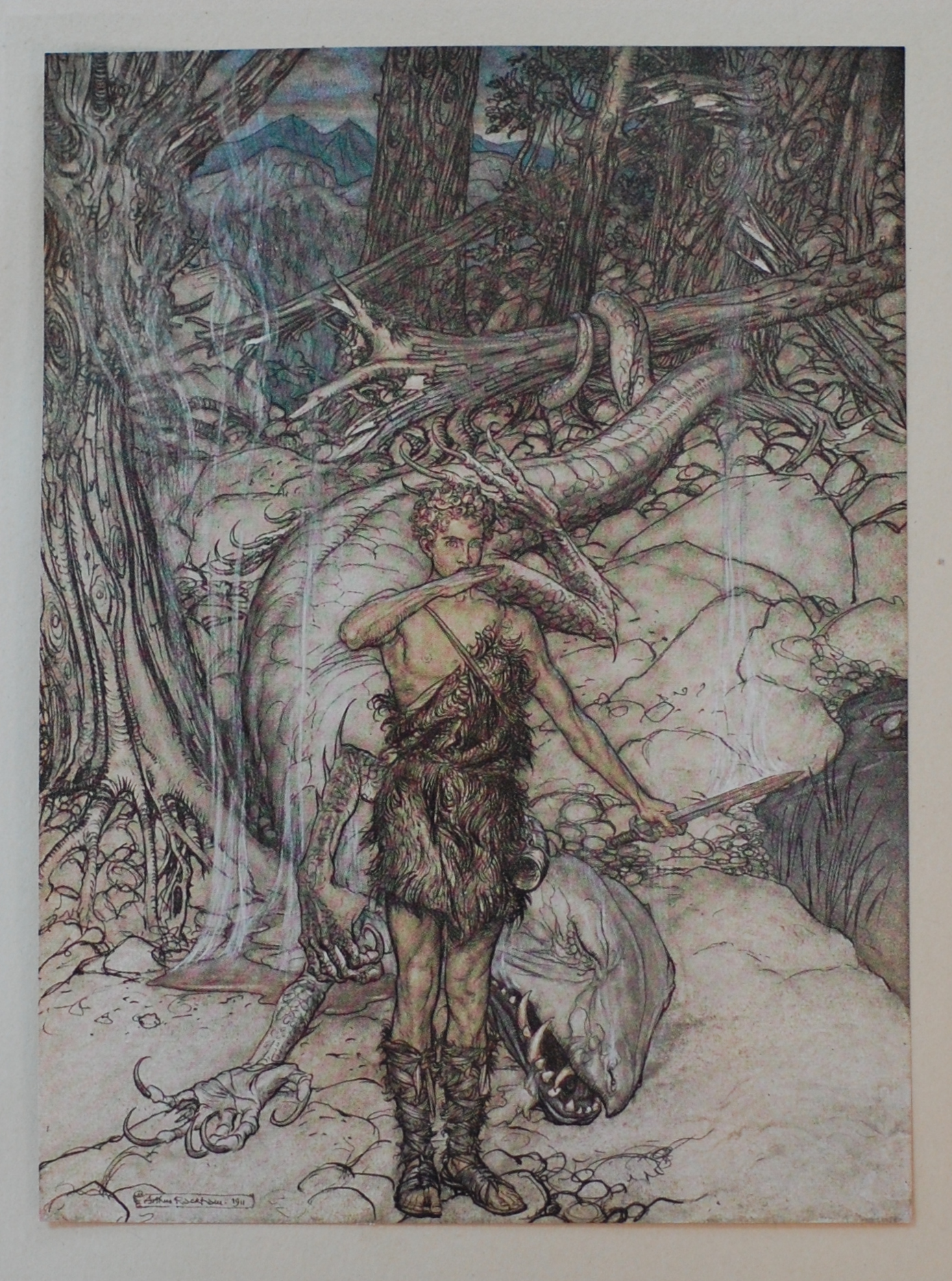
- Creator: Arthur Rackham September 19, 1867-September 6, 1939
- Description: This scene is from Siegfried in Volume II of Margaret Armour’s translation of Richard Wagner's Der Ring des Nibelungen. Wagner based his work largely on Old Norse sources preserved in Iceland and, to a lesser extent, on the German heroic poem Nibelunglied.Arthur Rackham's watercolour depicts Siegfried trying to soothe the burning sensation of Fafner’s blood on his hand by placing his hand in his mouth. After tasting Fafner’s blood, Siegfried is able to understand the speech of birds.The text for the illustration states,
- "The hot blood burns like fire!"
- Source: Volume II: Siegfried
- Folio or Page: [58]
- Medium: watercolour
- Date: 1939
- Dimensions (mm): 170 x 125
- Provenance: This illustration is from Special Collections in the MacPherson Library at the University of Victoria, Victoria, British Columbia, Canada. Call number: ML410 W195A7
- Rights:
This illustration from Siegfried is in the public domain.
-
Research notes, early print reviews, etc.:
Richard Wagner's Der Ring Des Nibelungen is commonly referred to in English as The Ring Cycle. The individual operas are 1) Das Rheingold (The Rhine Gold), 2) Die Walküre / Die Valküre (The Valkyrie), 3) Siegfried and 4) Götterdämmerung (The Twilight of the Gods).Árni Björnsson notes in Wagner and the Volsungs: Icelandic Sources of Der Ring Des Nibelungen that "the names and conduct of the gods are largely consistent with the descriptions given in the Prose Edda of Óðinn, Frigg, Freyja, Freyr, Þórr and Loki (SnE G20-35). The names have, however, existed in various different forms in Germanic dialects, and Wagner creates their characters with considerable freedom" (134).Björnsson remarks that “Wagner does not mention Siegfried digging holes to hide in, indeed this would not have been consistent with his concept of the fearless hero, who must of course face his enemy head-on” (198). He further notes that “The slaying of the dragon is recounted in the eddic poem Fáfnismál and in the Prose Edda (SnE S40), but the most detailed account is in Völsunga saga ch. 18” (199).Björnsson also notes that “The account of the dragon’s blood on the tongue, and understanding of the speech of birds, occurs in the Prose Edda (SnE S40), Völsunga saga chs 19 – 20, and in the…prose passage in the eddic poem Fáfnismál (between stanzas 31 and 32)” (202). - Bibliography:
Primary Source
Wagner, Richard. Der Ring des Nibelungen Leipzig: von J. J. Weber, 1863.Editions and Translations
Wagner, Richard. Sigfried & The Twilight of the Gods. Translated by Margaret Armour, London: William Heinemann Ltd. 1911.―. The Rhine Gold & The Valkyrie. Translated by Margaret Armour, London: William Heinemann Ltd. 1939.Secondary Sources
Björnsson, Árni. Wagner and the Volsungs : Icelandic Sources of Der Ring des Nibelungen. London: Viking Society for Northern Research, 2003. - Identity Number: RngNbLng-V02-058-Plt
- Download size: 141 MB
- Source code of this document: [XML]