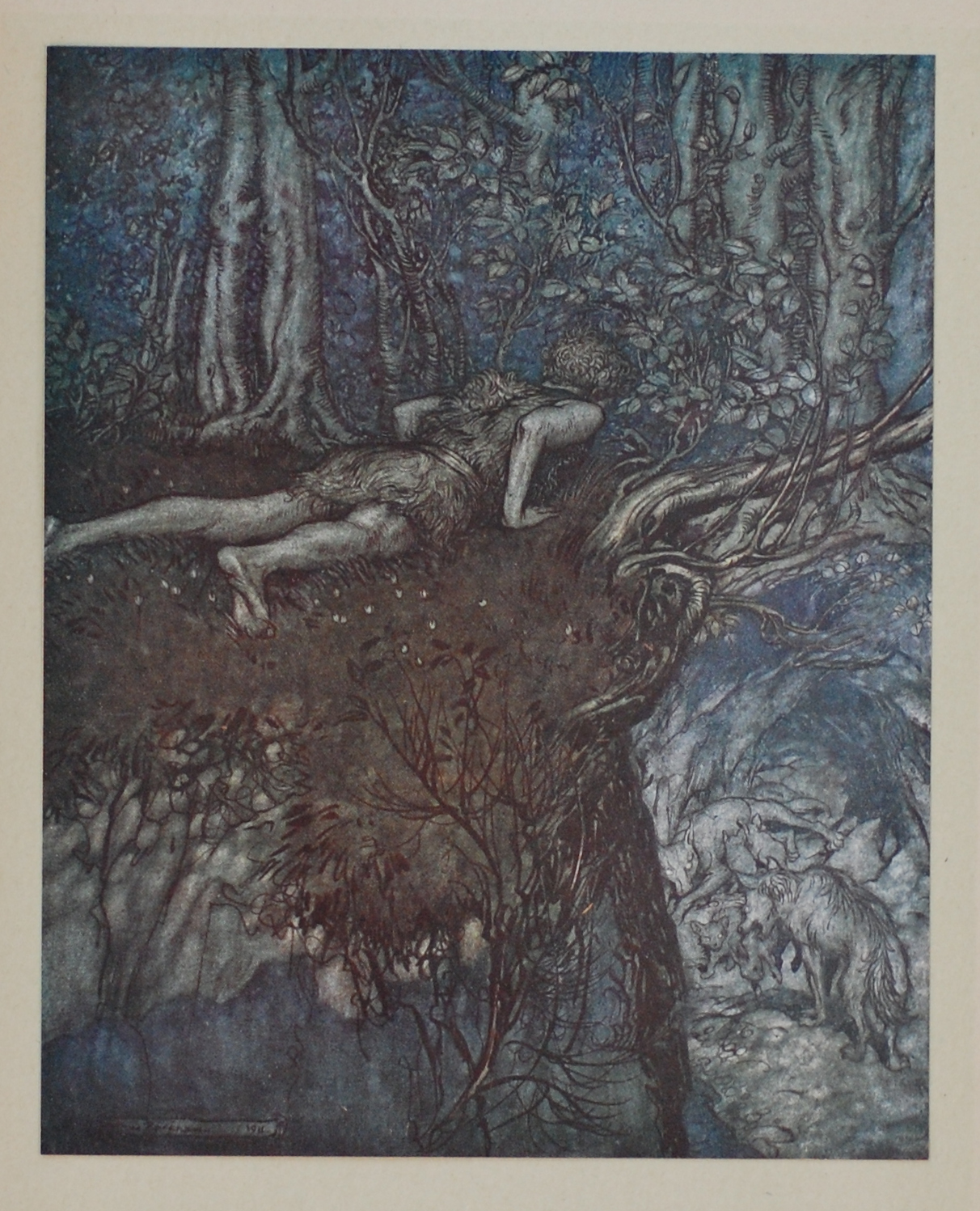
This scene is from Siegfried in Volume II of Margaret Armour’s
translation of Richard
Wagner's Der Ring des
Nibelungen. Wagner based his work largely on Old
Norse sources preserved in Iceland and, to a lesser extent, on
the German heroic poem Nibelunglied.
Arthur Rackham's
watercolour depicts Siegfried, as a youth, observing a family of
foxes in the forest.
The text for the illustration states,
"And there I learned
What love was like"
Source: Volume II: Siegfried
Folio or Page: [11]
Medium: watercolour
Date: 1939
Dimensions (mm): 180 x 125
Provenance:
This illustration is from Special
Collections in the MacPherson
Library at the University of Victoria, Victoria,
British Columbia, Canada. Call number: ML410 W195A7
Rights:
This illustration from Siegfried is in
the public domain.
Research notes, early print reviews, etc.:
Richard Wagner's Der Ring Des Nibelungen is
commonly referred to in English as The Ring Cycle.
The individual operas are 1) Das Rheingold (The Rhine Gold), 2) Die
Walküre / Die Valküre (The Valkyrie), 3) Siegfried and 4)
Götterdämmerung (The Twilight
of the Gods).
Árni Björnsson notes in Wagner and the Volsungs: Icelandic
Sources of Der Ring Des Nibelungen that
"the names and conduct of the gods are largely consistent with the
descriptions given in the Prose Edda of Óðinn, Frigg, Freyja, Freyr, Þórr
and Loki (SnE G20-35). The names have, however, existed in various different
forms in Germanic dialects, and Wagner creates their characters with
considerable freedom" (134).
Bibliography:
Primary Source
Wagner,
Richard. Der Ring des
Nibelungen
Leipzig: von J. J. Weber,
1863.
Editions and Translations
Wagner,
Richard. Sigfried & The Twilight of the Gods.
Translated by
Margaret
Armour,
London: William Heinemann
Ltd.
1911.
―. The Rhine Gold & The Valkyrie.
Translated by
Margaret
Armour,
London: William Heinemann
Ltd.
1912.
―. The Rhine Gold & The Valkyrie.
Translated by
Margaret
Armour,
London: William Heinemann
Ltd.
1939.
―. Sigfried & The Twilight of the
Gods.
Translated by
MargaretArmour,
London : William Heinemann Ltd.
1939.
Secondary Sources
Björnsson,
Árni. Wagner and the Volsungs : Icelandic Sources of Der Ring des
Nibelungen. London: Viking
Society for Northern Research, 2003.
Sigurðr
Fáfnisbani (non.)
Sigurd
the Dragon Slayer (en.)
Siegfried (ger.)
The legendary hero in Völsunga
Saga who killed the dragon Fáfnir, rode through the
flame wall to awaken Brynhildr. He promised to marry her but due to
sorcery married Guðrún and tricked Brynhildr into marrying
Gunnarr.
Richard Wagner based his hero Siegfried in The Ring
Cycle on Sigurðr.
Nouns
Edwardian (en.)The
Edwardian era began with the reign of King Edward VII, 1901 to 1910
(January 22, 1901 - July 28, 1914). However, the era's end date is
sometimes extended to the beginning of World War 1 (28 July
1914).
Victorian (en.)The
Victorian era began with the reign of Queen Victoria and ended with her
death (June 20, 1837 – January 22, 1901).
Source Materials:
Der Ring des Nibelungen (ger.)
The Ring Cycle (en.)
A group of four German operas composed by Richard Wagner that is
collectively known as Der Ring des
Nibelungen and in English as The Ring Cycle.
The individual operas are 1) Das Rheingold (The
Rhinegold), 2) Die Walküre / Die Valküre (The
Valkyrie), 3) Siegfried and 4) Götterdämmerung (The Twilight of the Gods). Wagner based
his work largely on Old Norse sources preserved in Iceland and to a
lesser extent on the German heroic poem Nibelunglied.
Siegfried
(opera) (ger.): The third of four German operas composed by
Richard Wagner that is collectively known as Der Ring des Nibelungen and in English as
The Ring Cycle. The individual operas are 1) Das Rheingold (The Rhinegold), 2) Die Walküre / Die Valküre (The Valkyrie), 3) Siegfried and 4) Götterdämmerung (The Twilight of the Gods). Wagner based
his work largely on Old Norse sources preserved in Iceland and to a
lesser extent on the German heroic poem Nibelunglied.
Source Persons
Armour,
Margaret (en.)
b. September 10, 1860
d. October 13, 1943
Nationality: Scottish
Occupation: poet, novelist, and translator
In 1910, Armour translated the four operas comprising Richard Wagner's
Der Ring des Nibelungen into
English. Her translation was published in two volumes. 1) Volume One:
Das Rheingold (The Rhinegold), and Die Walküre / Die Valküre (The
Valkyrie) was published in 1910, and Volume Two: Siegfried and
Götterdämmerung (The Twilight of the Gods) was published in 1911. The
volumes were illustrated by Arthur Rackham with a total of sixty-four
watercolours, as well as black and white vignettes and
tailpieces.
Rackham,
Arthur (en.)
b. 1867
d. 1939
Nationality: English
Occupation: illustrator
Residence: London
One of the most prominent illustrators during the Golden Age of
British Book Illustration (c. 1880 - 1930). His illustrations of Norse
mythology frequently appeared in "Little Folks" which were collected and
published in the Land of Enchantment. Rackham
also created 64 watercolours for the English translation of Richard
Wagner's Der Ring des Nibelungen
(1863), known in English as The Ring
of the Niblung, and sometimes as The
Ring Cycle. Rackham's illustrations first appeared in
Volume 1 of Margaret Armour's English translation, The Rhinegold and The Valkyrie, was published (1910),
and in Volume 2, Siegfried and The Twilight of the
Gods (1911). The images in MyNDIR are from the
1939 edition, with Rackham's illustration, and all four of the operas in
one volume.
Wagner,
Richard (ger.)
b. 16 September 1800
d. 4 December 1886
Nationality: German
Occupation: Author, Teacher and Philologist
Residence: Leipzig, Germany
German composer, theatre director, and conductor who wrote both the
music and the libretto for Der Ring des
Nibelungen opera.